

Date: 4th July 08, Thursday
Observation Time: 11:30pm to 12:52pm (1:20 hrs)
Location: SD Home, CA
Weather: Seeing was excellent. Heavy light pollution, Red haze in the background.
Instruments: My 10” dob.
Jon loaned me his 10" dob. He mentioned that he is not using it htat frequently and considering my enthu, he offered it to me for a while.
The views in 10" dob are fabulous. with more aperture and 9mm eyepiece, Jupiter was simply fabulous.
Jupiter: Observed at beginning and end of the session, to avg out the seeing conditions. Tried all eyepieces and magnification. 9mm x 2x barlow combo (266x) view was the best. Bright disk... Almost all bands. Upper central one (S) bigger, lower central one (N) smaller and shifted downwards off equator, two more bands on lower side (N). Lower central band had a dark circle at the edge in the center. Upper central dark band on left side (W) has some white saw tooth. and in the same band on the right side there is white circular spot on the upper right corner (NE). some dark spot next to upper band (above central band)on left central and immediately another dark spot at 11pm in next upper band (NW)
4 moons 2 left (W) and 2 right (E). Within an hour, Eastern lower moon shifted from right (E) to left (W) crossing the upper moon. the magnification was so high that all moons look like disks. i never seen moons as disks in my 6" dob.
M8 Lagoon: The nebulosity was almost invisible. Nice cluster in the view. cluster in a shape of crown.. like burger king crown advt... at the center of the crown there is tiny cross. Left side of the crown is some nebulocity.. two stars directly vertical, paralle to crown and are betn nebulosity and crown. another two stars close to each other and at 11 o'clock of the first two brigh stars... this second pair seems to be inside the nebulosity. Exellent view in the thru 25mm x 2x barlow (94x)and 9mm (133x) eyepiece
M20 Triffid: Only the cluster was visible and nebulosity was totally absent. I am not sure if I was looking at correct location. The cluster had nice V shape on the left. In the center had a nice triangle and 7 shape rotated by 90 deg. No nebulousity at all.
M7 Butterfly: found it easily.. shape was easily visible. the bright red star color was absent.. I think its night pollution that killed it. Seems like red whitish background of light pollution in the eyepiece.
M6 Ptolemy: Thought that M6 was easy to catch, but i guess it was too close to horizon.. so just didn't see it.
M22 Globular: Really nice cluster. Around 2 degrees NE from the gamma saggi. wasn;t able to resolve anything at 32mm (38x), but with 16mm and 12mm really nice view.. Infact 9mm (133x) view was excellent. 266x didn't help much. In 9mm almost resolved all stars.. cluster seems ot be devided in 3 parts. Off the center there is group of stars and all others stars are disperesed around it on Left and right side. No colors. 9mm eyepiece almost full in the view.
M28 Globular: NW side of gamma saggi around less than a degree. not able to resolve the stars with any magnification... with higher magnification just lost the cluster. this cluster is really tiny. compared to M22 globular its 1/4th in size. and its brightness seems lighter than M22, but i guess thats because of size.
Friday, July 4, 2008
Wednesday, July 2, 2008
First session with Jon Issacs...
Date: 28th June 08, Saturday
Observation Time: 8:30pm to 12:00pm (3:30 hrs)
Location: KC, CA
Weather: Seeing was “okay” not excellent. Lil bit windy and after 12:00 winds picked up. Not cold at all. Survived on t-shirt. Lil bit of light pollution on south because of border patrol check-post.
Buddies: Jon Issacs. Only two of us at this dark spot. Plenty of discussions.
Instruments: My 6” dob. Jon’s 12.5 discovery dob. Williams 80mm APO, 10x50 binocs.
Got in touch with Jon thru craigslist. Overall, in this observing session, I wanted to learn as much as possible thru Jon’s 20 years experience. I didn’t have any observation plan. The only thing which I had in mind is to point my 6” dob to each and every object that Jon points thru his 12.5” dob. Compare both views. Try Jon’s eyepieces on my dob, if possible and compare both views.
This is first time I tried the laser collimator. Jon has a nice 1.25” laser collimator. Initially I collimated my scope with my collimation cap. It wasn’t perfect, but almost there. With laser collimator, I realized how easy and precise collimation can be. Jon mentioned that my mirror cell seems to be push-pull cell and described me the use of locking vs collimating screws. In the process, we realized that my focuser tube is also having some problem. Optics doesn’t align properly when focuser tube is fully inwards vs fully outwards. Need to find out more.
Tried the collimation star test on Vega, but Jon mentioned that star tests are pretty good on small apertures or refractors. For big apertures its hard to see those concentric circles. Also seeing wasn’t good enough to try it on my scope.
Double Double: Able to resolve it at 96x only (25mm x 2x). Jon was able to resolve it with lower magnification. My vision is still not fully adapted to these observations. I also tried Jon’s 9mm eyepiece (135x), and seemed like it showed me high contrast in the view than my 25mm x 2x combo.
Saturn: It was close to horizon and was still under dusk. Seeing wasn’t that great. A moon aligned on left side of the rings and titan, aligned at 4 o’clock of rings, were clearly visible in my scope. Again, Cassini division eluded me. In Jon’s 12.5”, Saturn was beautiful & crisp. One more moon was visible next to the first one I saw in my scope. Rings were nice, but I didn’t pay attention to Cassini division. Damn it !!
M57: Ring Nebula: While observing for Ring nebula, got acquitted to left eyed finder on Jon’s 12.5” dob. He also mentioned a trick for locating objects thru finder by using both eyes so that the brain creates combined image of cross-hairs of finder on the naked eye sky image and it helps to quickly locate the objects. Its was lil bit difficult for me in the beginning, but I got used to it while locating star clusters in later session.
Because of dusk, the Ring nebula wasn’t a clear view, on my scope initially it looked like out of focus star, but with Jon’s 12.5 nebulosity was clear. We should have tried it late night. Also use of filter would have been useful.
I need to confirm and understand the location of Ring nebula in the map.
Omega Centauri: Initially wasn’t able to find it with naked eye. But browse thru binocular really helped. Thru Jon’s 12.5”, it was simply fabulous. I was able to resolve the stars in the outskirts of the globular, but the center was too dense. Whole eyepiece was filled up with the globular (don’t remember the magnification). Thru my scope, it was a nice image too.. but Jon had a better contrast than mine. Again it was too low on horizon and border patrol strong lights were killing it.
M4: Fabulous view thru Jon’s 12.5”. In my scope, the M4 and globular NGC 6144, next to Antares, were in same eyepiece view. Pretty nice.
Northern Jewel Box: NGC 6231: I always heard abt it, but never looked at it. Jon pointed to it. In the binocs, APO and finally in my scope. Beautiful !! didn't pay much attention to colors.
M6: Ptolemy’s cluster: It always looks better in wide angle or binoculars.
M7: Butterfly cluster: this is first time I indeed saw the butterfly shape in this cluster. The red star the end of the butterfly body was noteworthy. With my 32mm (38x) color of the red star was noteworthy, but with 3x barlow on it (76x), the color went down to orange. Jon’s 16mm Nagler (76x) eyepiece view was much wide angular than my 16mm setup. It looked nice thru Jon’s 80mm refractor.
M11: wild duck cluster: Nice view in 12.5” dob. Unable to see the shape: flock of flying ducks. I didn’t try it in my scope. We were star-hopping just too fast :), but I confirmed the location thru my binoculars.
M80: Jon pointed to it.. I saw it and forgot :). Just too fast star hopping !!
M8: Lagoon Nebula: While looking for M11 wild duck cluster in my scope, I accidently, pointed to a nebulous object and Jon mentioned that I am infact pointing to Lagoon nebula. I have seen and pointed to Lagoon before (8 months back), but I have just forgotten it completely.
Browsed through binoculars to locate Lagoon. M6 -> M7 -> Lagoon -> Triffid
The nebula also had a star cluster located at 2 o’clock of it. (NGC 6530). Fabulous view thru my 23mm (38x). We tried Jon’s Luminicon deep sky filter on it and nebulosity indeed became brighter. Lagoon was sort of in a circular shape. Second part of nebulosity was lying 1 o’clock to this circular shape and was bifurcated by a dark lane. Also I felt that another nebulosity part was there around 5 o’clock of this circular shape. No dark lane, but separation was clearly visible. Nice view thru Jon’s 12/5” dob. was able to see bright stars at the core of the nebula. Missed the hourglass nebula inside Lagoon. Need to observe carefully and with high magnification.
Missed Triffid and Swan.. instead we moved to Dumbbell nebula.
M27: Dumbbell Nebula: the interesting part of M27 was to indeed find it. Jon gave me amazing star-hopping session with binoculars to locate and confirm dumbbell nebula.
Altair -> three stars aligned with Altair in middle. -> 9 o’clock of Altair around 5 deg N (left) -> three sections aligned: Wider pair of stars + below it, shorter pair of stars + below it, single bright star. -> In between the middle shorter pair and single bright star, there are three stars in a cluster and M71 globular is next to it. -> back to middle shorter pair of stars and move to N (left) around 5 deg. Bright star. 4 o’clock of which is dumbbell nebula. -> Pair of stars at 9 o’clock of dumbbell is aligned to point to dumbbell -> Pair of stars at 11 o’clock of dumbbell is aligned to point to dumbbell
Also, From Altair -> Move to 11” 4 deg and see the Coat Hanger. This star alignment is fabulous and looks like real coat hanger :). Coat hanger extended W (up), points directly to dumbbell nebula.
Jon’s star-hopping skills are indeed commendable.
With this knowledge of alignments thru binoculars, it took me less than a minute to point my scope to dumbbell nebula.
Another fabulous view thru my 32mm (38x) and 25mm (48x). Had filter on 25mm. really bright nebulosity. Didn’t observe thru 12.5”
Leo triplet: M65 M67 NGC3628. With my previous TDS experience, I found it easily. Bad seeing and its was at 5 deg from horizon hill. Better look in 12.5”. Was able to see lil bit of dust lane in NGC3628
Jupiter: Extremely bright. 4 bands visible. 3 moons visible on right and one on left. 3 moons were not as a pointed star but more-ever like a disk..
Canes Venatici Galaxy Cluster: Hickson68 This is Jon’s favorite object. Observed thru 12.5” dob. Kite formation – First vertex is a Bright star. Below it was a tiny galaxy (NGC5350) as a second vertex and pair of galaxies as third vertex (NGC5354 & NGC5353). All three aligned in a straight line. Pair seemed to be brighter than stand alone one. Below it, there is another faint galaxy (NGC5355), edge on, at the fourth vertex aligned in a straight line with first vertex bright star. In the same eyepiece view, way down, there is another bright star and above it a bright and big galaxy (NGC 5371)… this was brighter and bigger than any other galaxies in the view. Jon didn’t remember numbers for these objects, but pointed to them with his excellent star-hopping skills. I didn’t have stamina to find them by myself :). Also there is supposed to be 5th member in Hickson 68 group in the same eyepiece view. Need careful observation next time.
M51: Whirlpool Galaxy While browsing in Ursa-Major, I asked Jon to look for M51 and M101. Again, both of us had excellent star-hopping session for these objects thru binoculars. M51 was an easy catch. Saw thru 16mm Nagler on my scope. Compared to (32mm x 2x) barlow combo, 16mm Nagler contrast view was great. Bad seeing, so hard to see the spiral structure. On12.5” dob, spiral structure was somewhat visible, but because bad seeing and less enthu, I didn’t delve into details.
M101: Thru binoculars it was easy catch, but I wasn’t able to catch it on my scope. I was too tired I guess.
Veil Nebula: Jon pointed his 12.5” dob on both parts of nebula. In first part, central bright star (52 Cygnus). Nebulosity on both side. Right side nebulosity brighter than left side, but left side size is bigger than the right side. Second part thru my scope. Impressive view. Tried with 32mm filter. Also tried to understand the precise location. Pretty easy to confirm location because of 52 Cygnus star. Now I have read more description abt this nebula, I should be able to observe it in finer details.
Alberio: Just before leaving, I pointed to Alberio to see the colors. Immediate split with 32mm. nice golden and green/bluish pair.
Overall, It was great session. More than 20 DSOs and two planets. Two doubles. Learnt a lot abt telescope, eyepieces, collimation and star-hopping. Jon also mentioned that he liked my technique of star hopping thru clock positions. It was first time he heard abt it and indeed liked it. On the negative side, I felt like we rushed really fast in the whole session. It should have been lil bit slow with details observations and discussing those. Also whole session was without dinner :). If I would have eaten something in the middle, I would have preferred to stay longer.
Any way, Last two months or last 8-10 weeks are THE BEST time of my astronomy life. Moving to "next level" pretty fast, unexpectedly.
Observation Time: 8:30pm to 12:00pm (3:30 hrs)
Location: KC, CA
Weather: Seeing was “okay” not excellent. Lil bit windy and after 12:00 winds picked up. Not cold at all. Survived on t-shirt. Lil bit of light pollution on south because of border patrol check-post.
Buddies: Jon Issacs. Only two of us at this dark spot. Plenty of discussions.
Instruments: My 6” dob. Jon’s 12.5 discovery dob. Williams 80mm APO, 10x50 binocs.
Got in touch with Jon thru craigslist. Overall, in this observing session, I wanted to learn as much as possible thru Jon’s 20 years experience. I didn’t have any observation plan. The only thing which I had in mind is to point my 6” dob to each and every object that Jon points thru his 12.5” dob. Compare both views. Try Jon’s eyepieces on my dob, if possible and compare both views.
This is first time I tried the laser collimator. Jon has a nice 1.25” laser collimator. Initially I collimated my scope with my collimation cap. It wasn’t perfect, but almost there. With laser collimator, I realized how easy and precise collimation can be. Jon mentioned that my mirror cell seems to be push-pull cell and described me the use of locking vs collimating screws. In the process, we realized that my focuser tube is also having some problem. Optics doesn’t align properly when focuser tube is fully inwards vs fully outwards. Need to find out more.
Tried the collimation star test on Vega, but Jon mentioned that star tests are pretty good on small apertures or refractors. For big apertures its hard to see those concentric circles. Also seeing wasn’t good enough to try it on my scope.
Double Double: Able to resolve it at 96x only (25mm x 2x). Jon was able to resolve it with lower magnification. My vision is still not fully adapted to these observations. I also tried Jon’s 9mm eyepiece (135x), and seemed like it showed me high contrast in the view than my 25mm x 2x combo.
Saturn: It was close to horizon and was still under dusk. Seeing wasn’t that great. A moon aligned on left side of the rings and titan, aligned at 4 o’clock of rings, were clearly visible in my scope. Again, Cassini division eluded me. In Jon’s 12.5”, Saturn was beautiful & crisp. One more moon was visible next to the first one I saw in my scope. Rings were nice, but I didn’t pay attention to Cassini division. Damn it !!
M57: Ring Nebula: While observing for Ring nebula, got acquitted to left eyed finder on Jon’s 12.5” dob. He also mentioned a trick for locating objects thru finder by using both eyes so that the brain creates combined image of cross-hairs of finder on the naked eye sky image and it helps to quickly locate the objects. Its was lil bit difficult for me in the beginning, but I got used to it while locating star clusters in later session.
Because of dusk, the Ring nebula wasn’t a clear view, on my scope initially it looked like out of focus star, but with Jon’s 12.5 nebulosity was clear. We should have tried it late night. Also use of filter would have been useful.
I need to confirm and understand the location of Ring nebula in the map.
Omega Centauri: Initially wasn’t able to find it with naked eye. But browse thru binocular really helped. Thru Jon’s 12.5”, it was simply fabulous. I was able to resolve the stars in the outskirts of the globular, but the center was too dense. Whole eyepiece was filled up with the globular (don’t remember the magnification). Thru my scope, it was a nice image too.. but Jon had a better contrast than mine. Again it was too low on horizon and border patrol strong lights were killing it.
M4: Fabulous view thru Jon’s 12.5”. In my scope, the M4 and globular NGC 6144, next to Antares, were in same eyepiece view. Pretty nice.
Northern Jewel Box: NGC 6231: I always heard abt it, but never looked at it. Jon pointed to it. In the binocs, APO and finally in my scope. Beautiful !! didn't pay much attention to colors.
M6: Ptolemy’s cluster: It always looks better in wide angle or binoculars.
M7: Butterfly cluster: this is first time I indeed saw the butterfly shape in this cluster. The red star the end of the butterfly body was noteworthy. With my 32mm (38x) color of the red star was noteworthy, but with 3x barlow on it (76x), the color went down to orange. Jon’s 16mm Nagler (76x) eyepiece view was much wide angular than my 16mm setup. It looked nice thru Jon’s 80mm refractor.
M11: wild duck cluster: Nice view in 12.5” dob. Unable to see the shape: flock of flying ducks. I didn’t try it in my scope. We were star-hopping just too fast :), but I confirmed the location thru my binoculars.
M80: Jon pointed to it.. I saw it and forgot :). Just too fast star hopping !!
M8: Lagoon Nebula: While looking for M11 wild duck cluster in my scope, I accidently, pointed to a nebulous object and Jon mentioned that I am infact pointing to Lagoon nebula. I have seen and pointed to Lagoon before (8 months back), but I have just forgotten it completely.
Browsed through binoculars to locate Lagoon. M6 -> M7 -> Lagoon -> Triffid
The nebula also had a star cluster located at 2 o’clock of it. (NGC 6530). Fabulous view thru my 23mm (38x). We tried Jon’s Luminicon deep sky filter on it and nebulosity indeed became brighter. Lagoon was sort of in a circular shape. Second part of nebulosity was lying 1 o’clock to this circular shape and was bifurcated by a dark lane. Also I felt that another nebulosity part was there around 5 o’clock of this circular shape. No dark lane, but separation was clearly visible. Nice view thru Jon’s 12/5” dob. was able to see bright stars at the core of the nebula. Missed the hourglass nebula inside Lagoon. Need to observe carefully and with high magnification.
Missed Triffid and Swan.. instead we moved to Dumbbell nebula.
M27: Dumbbell Nebula: the interesting part of M27 was to indeed find it. Jon gave me amazing star-hopping session with binoculars to locate and confirm dumbbell nebula.
Altair -> three stars aligned with Altair in middle. -> 9 o’clock of Altair around 5 deg N (left) -> three sections aligned: Wider pair of stars + below it, shorter pair of stars + below it, single bright star. -> In between the middle shorter pair and single bright star, there are three stars in a cluster and M71 globular is next to it. -> back to middle shorter pair of stars and move to N (left) around 5 deg. Bright star. 4 o’clock of which is dumbbell nebula. -> Pair of stars at 9 o’clock of dumbbell is aligned to point to dumbbell -> Pair of stars at 11 o’clock of dumbbell is aligned to point to dumbbell
Also, From Altair -> Move to 11” 4 deg and see the Coat Hanger. This star alignment is fabulous and looks like real coat hanger :). Coat hanger extended W (up), points directly to dumbbell nebula.
Jon’s star-hopping skills are indeed commendable.
With this knowledge of alignments thru binoculars, it took me less than a minute to point my scope to dumbbell nebula.
Another fabulous view thru my 32mm (38x) and 25mm (48x). Had filter on 25mm. really bright nebulosity. Didn’t observe thru 12.5”
Leo triplet: M65 M67 NGC3628. With my previous TDS experience, I found it easily. Bad seeing and its was at 5 deg from horizon hill. Better look in 12.5”. Was able to see lil bit of dust lane in NGC3628
Jupiter: Extremely bright. 4 bands visible. 3 moons visible on right and one on left. 3 moons were not as a pointed star but more-ever like a disk..
Canes Venatici Galaxy Cluster: Hickson68 This is Jon’s favorite object. Observed thru 12.5” dob. Kite formation – First vertex is a Bright star. Below it was a tiny galaxy (NGC5350) as a second vertex and pair of galaxies as third vertex (NGC5354 & NGC5353). All three aligned in a straight line. Pair seemed to be brighter than stand alone one. Below it, there is another faint galaxy (NGC5355), edge on, at the fourth vertex aligned in a straight line with first vertex bright star. In the same eyepiece view, way down, there is another bright star and above it a bright and big galaxy (NGC 5371)… this was brighter and bigger than any other galaxies in the view. Jon didn’t remember numbers for these objects, but pointed to them with his excellent star-hopping skills. I didn’t have stamina to find them by myself :). Also there is supposed to be 5th member in Hickson 68 group in the same eyepiece view. Need careful observation next time.
M51: Whirlpool Galaxy While browsing in Ursa-Major, I asked Jon to look for M51 and M101. Again, both of us had excellent star-hopping session for these objects thru binoculars. M51 was an easy catch. Saw thru 16mm Nagler on my scope. Compared to (32mm x 2x) barlow combo, 16mm Nagler contrast view was great. Bad seeing, so hard to see the spiral structure. On12.5” dob, spiral structure was somewhat visible, but because bad seeing and less enthu, I didn’t delve into details.
M101: Thru binoculars it was easy catch, but I wasn’t able to catch it on my scope. I was too tired I guess.
Veil Nebula: Jon pointed his 12.5” dob on both parts of nebula. In first part, central bright star (52 Cygnus). Nebulosity on both side. Right side nebulosity brighter than left side, but left side size is bigger than the right side. Second part thru my scope. Impressive view. Tried with 32mm filter. Also tried to understand the precise location. Pretty easy to confirm location because of 52 Cygnus star. Now I have read more description abt this nebula, I should be able to observe it in finer details.
Alberio: Just before leaving, I pointed to Alberio to see the colors. Immediate split with 32mm. nice golden and green/bluish pair.
Overall, It was great session. More than 20 DSOs and two planets. Two doubles. Learnt a lot abt telescope, eyepieces, collimation and star-hopping. Jon also mentioned that he liked my technique of star hopping thru clock positions. It was first time he heard abt it and indeed liked it. On the negative side, I felt like we rushed really fast in the whole session. It should have been lil bit slow with details observations and discussing those. Also whole session was without dinner :). If I would have eaten something in the middle, I would have preferred to stay longer.
Any way, Last two months or last 8-10 weeks are THE BEST time of my astronomy life. Moving to "next level" pretty fast, unexpectedly.
Tuesday, June 17, 2008
Moon Geological Period & Jupiter Belts
Date: 15 & 16th June 08, Sunday & Monday
Observation Time: 11:30pm to 1am (1:30 hr) on both days
Location: SD Home, CA
Weather: Seeing was excellent. Because of moon light, whole sky was washed out.
Highlight of the Night: Moon geological period and Jupiter disk.
Phase of the moon: 2 days before full moon. Waxing gibbous with 96% of the Moon's visible disk illuminated.
Watched moon on both sun & mon. Mainly at 194x, with 12mm 2x barlow.
Followed the terminator from SW corner to NW. Crater Schikard, Fourier, humorium basin, Eddington basin and Crater Pythagoras.
The main thing I focused on is to get the angular judgment of the size and distance of these craters compared other prominent feature. e.g. It was fun to measure distances between Crater Kepler to Enke, which was ~4deg.. and Kepler-Mauris around ~12 deg. Again these distances are just rough estimation, but it was fun to get the judgment correct.
Another thing i focused on is to understand the geological time scale of these features. E.g crater Tycho being in Copernitian period, while crater Phtyagoras is in Eratosthenes period... means tycho being much younger than pythagoras, which must be younger than nearby crater babbage which must be younger than crater archimedese or crater plato. This estimation of age was fun to track.
Watched Jupiter on both sun/mon. On sunday, Just watched it for 5 mins and clouds rolled over. On monday spent more than 20mins. Overall, I saw jupiter with really good clarity. On sunday, Calisto was transitioning on Jupiter at the NE edge..
Most of the observations of Jupiter were at 194x, with 12mm 2x barlow. I used blue, green and red filter on it. The blue and green filters were indeed helpful. I also tried the moon filter on jupiter.. it indeed reduced the brightness of jupiter disk.. but din't help anything more than that.
North equatorial belt south equatorial belt were clearly visible. northen belt seems to be darker than southern one, but southern one is surely wider than nourthen one. Also, with some effort, I saw N & S polar regions as well. also, I saw the north tropical zone gap. I felt its existence because that area is like a strip which is brigher/white than the north eq belt.
It must be fun to watch Jupiter without moonlight.. also at 250x and above. Lack of high magnification eyepiece indeed made me sad :) !!
Any way, it was first time, I watched Jupiter so seriously and with such a clarity.. It was indeed a good learning experience on how you can train your eyes to see a object.
Observation Time: 11:30pm to 1am (1:30 hr) on both days
Location: SD Home, CA
Weather: Seeing was excellent. Because of moon light, whole sky was washed out.
Highlight of the Night: Moon geological period and Jupiter disk.
Phase of the moon: 2 days before full moon. Waxing gibbous with 96% of the Moon's visible disk illuminated.
Watched moon on both sun & mon. Mainly at 194x, with 12mm 2x barlow.
Followed the terminator from SW corner to NW. Crater Schikard, Fourier, humorium basin, Eddington basin and Crater Pythagoras.
The main thing I focused on is to get the angular judgment of the size and distance of these craters compared other prominent feature. e.g. It was fun to measure distances between Crater Kepler to Enke, which was ~4deg.. and Kepler-Mauris around ~12 deg. Again these distances are just rough estimation, but it was fun to get the judgment correct.
Another thing i focused on is to understand the geological time scale of these features. E.g crater Tycho being in Copernitian period, while crater Phtyagoras is in Eratosthenes period... means tycho being much younger than pythagoras, which must be younger than nearby crater babbage which must be younger than crater archimedese or crater plato. This estimation of age was fun to track.
Watched Jupiter on both sun/mon. On sunday, Just watched it for 5 mins and clouds rolled over. On monday spent more than 20mins. Overall, I saw jupiter with really good clarity. On sunday, Calisto was transitioning on Jupiter at the NE edge..
Most of the observations of Jupiter were at 194x, with 12mm 2x barlow. I used blue, green and red filter on it. The blue and green filters were indeed helpful. I also tried the moon filter on jupiter.. it indeed reduced the brightness of jupiter disk.. but din't help anything more than that.
North equatorial belt south equatorial belt were clearly visible. northen belt seems to be darker than southern one, but southern one is surely wider than nourthen one. Also, with some effort, I saw N & S polar regions as well. also, I saw the north tropical zone gap. I felt its existence because that area is like a strip which is brigher/white than the north eq belt.
It must be fun to watch Jupiter without moonlight.. also at 250x and above. Lack of high magnification eyepiece indeed made me sad :) !!
Any way, it was first time, I watched Jupiter so seriously and with such a clarity.. It was indeed a good learning experience on how you can train your eyes to see a object.
Thursday, June 12, 2008
Lunar Mare Imbrium
Date: 12th June 08, Thursday
Observation Time: 9:15pm to 10:30pm (1:15 hrs)
Location: SD Home, CA
Weather: Seeing was excellent. Clouds started coming over afterwards.. so was hard to focus with high magnification.
Highlight of the Night: Mare Imbrium and Crater Sarabhai
Phase of the Moon: 10th day after new moon. waxing gibbous with 79% of the Moon's visible disk illuminated.
Initially took me a while to figure out where is the terminator lying in the map. I thought that it is in Mare Serentatis, but it was in Mare Imbrium. Good part is figuring out N-S-E-W in the eyepiece was easy. so looking into the map was easy afterwards.
Most of the observation was with 184x magnification, 12mm with 2x Barlow. Occasionaly I switched to 96x, with 25mm, 2x barlow. Moon filter was indeed helpful at 96x. At 184x i preferred to observe without it.
Mare imbrium is indeed nice, with bunch of Craters: Copernicus, Eratosthenes, Archimedes and Plato.
Crater Copernicus western wall was striking bright, i guess because of sun light. Its really rough wall, or possibly multiple walls. Crater walls seemed pretty deep. At the center there are 2 prominent peaks, strikingly white in color.
Crater Eratosthenes is at the beginning of mountain range, Its features are like small scale Copernicus...except.. at the center of this crate, it has 3 peaks in triangular fashion.
Map says that the mountain range near Eratosthenes is of ~3000m elevation... but really didn't feel it.. I think if i would have observed couple of days before, i would have able to feel the height because of shadow. The mnt range at W and NW wall of Mare Imbirum seemed pretty tall. these mnt were in the dark, after the terminator, but their peaks were bright in the dark, must be because of their height.. I will watch them again tomorrow and will confirm it.
Crater Archimedes: Its a filled up crater, really smooth. nothing special with walls .. neigther have any central peak... but SW of it, there is some what rough area.. small scale mountain range.
Crate Plato at N of the Mare.. is indeed nice. Compared to other craters, size wise: Plato >> Copernicus > Archimedes > Eratosthenes. This is also a smooth, fllled up crater , no peaks. The W wall of this crater is impressive, the large rock sliding is visible.
As i mentioned in the beginning, I interpreted Mare Imbrium as Mare Serentatis.. so I opened a map of Serentatis.. and guess what... it has a really tiny crater called as "Sarabhai" .. It is named after Dr Vikram Sarabhai, ISRO founder. Felt really good. I should find out, if any other Indian celebrities are reached to the moon.
Crater Sarbhai is nothing special. Its really really tiny. only 7km wide, as compared to Copernicus being 93km It was really hard for me to catch it at 96x. At mag 184x, it was visible clearly, but no details..
TBD:
- Lunar regions named after Indian celebrities.
Observation Time: 9:15pm to 10:30pm (1:15 hrs)
Location: SD Home, CA
Weather: Seeing was excellent. Clouds started coming over afterwards.. so was hard to focus with high magnification.
Highlight of the Night: Mare Imbrium and Crater Sarabhai
Phase of the Moon: 10th day after new moon. waxing gibbous with 79% of the Moon's visible disk illuminated.
Initially took me a while to figure out where is the terminator lying in the map. I thought that it is in Mare Serentatis, but it was in Mare Imbrium. Good part is figuring out N-S-E-W in the eyepiece was easy. so looking into the map was easy afterwards.
Most of the observation was with 184x magnification, 12mm with 2x Barlow. Occasionaly I switched to 96x, with 25mm, 2x barlow. Moon filter was indeed helpful at 96x. At 184x i preferred to observe without it.
Mare imbrium is indeed nice, with bunch of Craters: Copernicus, Eratosthenes, Archimedes and Plato.
Crater Copernicus western wall was striking bright, i guess because of sun light. Its really rough wall, or possibly multiple walls. Crater walls seemed pretty deep. At the center there are 2 prominent peaks, strikingly white in color.
Crater Eratosthenes is at the beginning of mountain range, Its features are like small scale Copernicus...except.. at the center of this crate, it has 3 peaks in triangular fashion.
Map says that the mountain range near Eratosthenes is of ~3000m elevation... but really didn't feel it.. I think if i would have observed couple of days before, i would have able to feel the height because of shadow. The mnt range at W and NW wall of Mare Imbirum seemed pretty tall. these mnt were in the dark, after the terminator, but their peaks were bright in the dark, must be because of their height.. I will watch them again tomorrow and will confirm it.
Crater Archimedes: Its a filled up crater, really smooth. nothing special with walls .. neigther have any central peak... but SW of it, there is some what rough area.. small scale mountain range.
Crate Plato at N of the Mare.. is indeed nice. Compared to other craters, size wise: Plato >> Copernicus > Archimedes > Eratosthenes. This is also a smooth, fllled up crater , no peaks. The W wall of this crater is impressive, the large rock sliding is visible.
As i mentioned in the beginning, I interpreted Mare Imbrium as Mare Serentatis.. so I opened a map of Serentatis.. and guess what... it has a really tiny crater called as "Sarabhai" .. It is named after Dr Vikram Sarabhai, ISRO founder. Felt really good. I should find out, if any other Indian celebrities are reached to the moon.
Crater Sarbhai is nothing special. Its really really tiny. only 7km wide, as compared to Copernicus being 93km It was really hard for me to catch it at 96x. At mag 184x, it was visible clearly, but no details..
TBD:
- Lunar regions named after Indian celebrities.
Sunday, June 1, 2008
31st May 08 @ TDS
Date: 31st May 08, Saturday
Observation Time: 8:30pm to 12:00pm (3:30 hrs)
Location: TDS, CA
Weather: Seeing was “okay” initially, but afterwards it improved, but still not excellent. Cloud cover was always there near horizon. Little bit breezy till 10pm. and it was freaking cold.. 44 deg F. If yahoo weather say “almost clear', then think before heading to TDS.
Buddies: Bill from next pad. Didn't talk with him much..
Highlight of the night: I cracked complete Leo constellation DSOs and surprise look of Omega Centauri.
Another constructive session at TDS. Actually I wasn't sure abt visiting TDS, because of late afternoon lunch at friend's daughter's first birthday party. So was somewhat tired.. but 25 mins nap did the magic, and ended up gong to TDS late evening.
Observation Time: 8:30pm to 12:00pm (3:30 hrs)
Location: TDS, CA
Weather: Seeing was “okay” initially, but afterwards it improved, but still not excellent. Cloud cover was always there near horizon. Little bit breezy till 10pm. and it was freaking cold.. 44 deg F. If yahoo weather say “almost clear', then think before heading to TDS.
Buddies: Bill from next pad. Didn't talk with him much..
Highlight of the night: I cracked complete Leo constellation DSOs and surprise look of Omega Centauri.
Another constructive session at TDS. Actually I wasn't sure abt visiting TDS, because of late afternoon lunch at friend's daughter's first birthday party. So was somewhat tired.. but 25 mins nap did the magic, and ended up gong to TDS late evening.
Not many people were around.. probably 6-8 telescopes. Weather was awful when I was driving to TDS. The clear sky clock showed few “faint blues”, while yahoo weather had a doubt with “Almost” clear.
Faced some trouble with collimation.. I think primary mirror is not fully visible in secondary.. I tried my best.. but still I think its still wrong.. wasn't able to focus on Saturn precisely.. I was seeing the double images except the fine tuned point.. I should not see double images.. out of focus is okay.
**** Saturn:
Because of bad weather,, I started with Saturn. In32mm, 38x, Saturn was perfectly visible with 3 moons. 2 on one side, while one on another. Rings were visible with a separation from planet. 97x with 25mm 2x barlow, indeed showed something dark band on Saturn. Ring's overlap over the planet was clearly visible.. still wasn't able to see cassini division. Its hard to keep saturn in high mag view.
Because of bad weather,, I started with Saturn. In32mm, 38x, Saturn was perfectly visible with 3 moons. 2 on one side, while one on another. Rings were visible with a separation from planet. 97x with 25mm 2x barlow, indeed showed something dark band on Saturn. Ring's overlap over the planet was clearly visible.. still wasn't able to see cassini division. Its hard to keep saturn in high mag view.
*** Leo
I followed again the cloudy night article regarding “Leo”.. page by page..
I followed again the cloudy night article regarding “Leo”.. page by page..
> M65 – M66 – NGC 3628 Triplet
It was again perfect catch absolutely no trouble. in finding it. all three visible in same view. NGC 3628 was really faint. View was not that great, because of bad seeing I guess.. Didn't try high magnification.
It was again perfect catch absolutely no trouble. in finding it. all three visible in same view. NGC 3628 was really faint. View was not that great, because of bad seeing I guess.. Didn't try high magnification.
> NGC 3607 – 3608 – 3605 Triplet
Easy to find. all three lined up in a triangle. The one in the middle is really bright, other two were barely visible to me. Required averted vision. Infact I am not sure if I saw correct one.. I have a sketch with galaxy and surrounding stars and its not matching with cloudy nights.. I need to verify with ma10 sky chart.
Easy to find. all three lined up in a triangle. The one in the middle is really bright, other two were barely visible to me. Required averted vision. Infact I am not sure if I saw correct one.. I have a sketch with galaxy and surrounding stars and its not matching with cloudy nights.. I need to verify with ma10 sky chart.
> M95 – M96 – M105 Triplet
this time I located it precisely and in first shot :) .. The stars “p”, 53, 52 and 43 form perfect trapezoid. and in the same view finder. If we take perfect mid-point of 52 & 53, thats where galaxy triplet can be found. All three can not be in same view, some bright star, M105 and M96 are in perfect view like a right angle triangle.. if we pick up M96, then another 90 deg twist gives M95.. perfectly aligned. so all four objects for one-side angled square.
this time I located it precisely and in first shot :) .. The stars “p”, 53, 52 and 43 form perfect trapezoid. and in the same view finder. If we take perfect mid-point of 52 & 53, thats where galaxy triplet can be found. All three can not be in same view, some bright star, M105 and M96 are in perfect view like a right angle triangle.. if we pick up M96, then another 90 deg twist gives M95.. perfectly aligned. so all four objects for one-side angled square.
M96 is the brighter between them. M105 and M95 seemed of same magnitude. M95 seems to be the bigger in size than M96. I need to verify these observations.
> M105 – NGC3371 – NGC3373 Triplet
3371-73 should have been 3384 and 3389.
M105 itself is a triplet. M105 is at 6 o'clock from the bright star. 3371 is at 8 o'clock. There are 3 stars lined up on right side of 105-3371 line. If we pick up the middle star, then with averted vision, 3373 is clearly visible. Simply fabulous !! 3373 is just too faint and tiny.. 3371 is bigger and brighter than 3373 and can be seen fairly.. Bill from next pad was happy to see the triplet-triplets..but 3373 was too hard for him.
3371-73 should have been 3384 and 3389.
M105 itself is a triplet. M105 is at 6 o'clock from the bright star. 3371 is at 8 o'clock. There are 3 stars lined up on right side of 105-3371 line. If we pick up the middle star, then with averted vision, 3373 is clearly visible. Simply fabulous !! 3373 is just too faint and tiny.. 3371 is bigger and brighter than 3373 and can be seen fairly.. Bill from next pad was happy to see the triplet-triplets..but 3373 was too hard for him.
> NGC 2903
Following pocket sky atlas, gave me the precise location of this guy and easy to catch. it looked like as elongated as NGC 3268, Nothing much special..
Following pocket sky atlas, gave me the precise location of this guy and easy to catch. it looked like as elongated as NGC 3268, Nothing much special..
> Alpha Leonid – Regulus:
I am still not able to resolve this double star. .not able to resolve it with 6mm also, 184x.. Freaking, there is something terribly wrong.
I am still not able to resolve this double star. .not able to resolve it with 6mm also, 184x.. Freaking, there is something terribly wrong.
> Gamma Leonid – Algieba:
This double star is fabulous. in 32mm, 38x not able to resolve it, but 76x showed me the “peanut” shape. companion is so close and smaller than gamma, so it looks like uneven 8 or a peanut. Both of them golden yellowish color.
This double star is fabulous. in 32mm, 38x not able to resolve it, but 76x showed me the “peanut” shape. companion is so close and smaller than gamma, so it looks like uneven 8 or a peanut. Both of them golden yellowish color.
I am done with Leo now.. need to move to new one.. probably virgo !!
*** Cancer
> M44 – Beehive cluster – fabulous as usual !!
> M44 – Beehive cluster – fabulous as usual !!
> M67 – open cluster – not as impressive as M44.. its really tiny. but its hard to locate.
*** Omega Centauri
This is first time I saw this glob in my life.. From India, for the roof of my place in pune, I have seen it., but I never knew that this is THE BEST glob in whole night sky. and yesterday I saw it.. Initially thru my binocs 10x50. its almost 4 times the size of M13 Hercules glob. M13 is really tiny in front of this one. Its naked eye... 2-3 deg from southern horizon. At 38x with 32mm, it was fabulous.. not able to resolve any stars, but it was too dense more than a cotton.. really fuzzy !! 32mm with 2x barlow, 72x resolved some outskirt stars, but 25mm 2x 98x was indeed impressive... more you look in the eyepiece, the more you have adapted your eyes to the view, the more I was able to resolve the stars in it.. all of them seemed to be of same color. Again as it was too densely packed.. I am just not able to see any shape.. This was-is indeed memorable sight !!
This is first time I saw this glob in my life.. From India, for the roof of my place in pune, I have seen it., but I never knew that this is THE BEST glob in whole night sky. and yesterday I saw it.. Initially thru my binocs 10x50. its almost 4 times the size of M13 Hercules glob. M13 is really tiny in front of this one. Its naked eye... 2-3 deg from southern horizon. At 38x with 32mm, it was fabulous.. not able to resolve any stars, but it was too dense more than a cotton.. really fuzzy !! 32mm with 2x barlow, 72x resolved some outskirt stars, but 25mm 2x 98x was indeed impressive... more you look in the eyepiece, the more you have adapted your eyes to the view, the more I was able to resolve the stars in it.. all of them seemed to be of same color. Again as it was too densely packed.. I am just not able to see any shape.. This was-is indeed memorable sight !!
*** Ursa Major
After dinner, I tracked few objects in big dipper. I should have read the cloudy nights article in detail.
After dinner, I tracked few objects in big dipper. I should have read the cloudy nights article in detail.
> M81 – M82 pair:
M81 is indeed brighter & bigger than M82. M81 is edge on.. again both of them seemed to be too faint to observe anything.. again following sky atlas pointed perfect location and first shot catch !! high mag didn't help much !!
M81 is indeed brighter & bigger than M82. M81 is edge on.. again both of them seemed to be too faint to observe anything.. again following sky atlas pointed perfect location and first shot catch !! high mag didn't help much !!
> M108 galaxy – M97 Owl nebula pair:
This was indeed hard to catch because of my stupidity. I misinterpreted the view through finder and was looking on the opposite direction of “beta”.. moment I realized my mistake, in next attempt the pair was in my eyepiece.. its indeed fainter than M81-M82 pair.. the distance between them is more than 81-82 pair. Again high mag really made them faint.. M97 is indeed brighter than M108. M97 is in perfect circular shape while M018 is elongated edge on.
This was indeed hard to catch because of my stupidity. I misinterpreted the view through finder and was looking on the opposite direction of “beta”.. moment I realized my mistake, in next attempt the pair was in my eyepiece.. its indeed fainter than M81-M82 pair.. the distance between them is more than 81-82 pair. Again high mag really made them faint.. M97 is indeed brighter than M108. M97 is in perfect circular shape while M018 is elongated edge on.
> M109 - It was too faint .. I don't remember much !! it was yet another DSO.. nothing more..
> M51 whirlpool galaxy:
This was indeed great. clearly visible in 32mm, 38x.. pretty bright.. in 8 shaped with left galaxy smaller than right one. but both of them were brighter.. high mag didn't show much !!
This was indeed great. clearly visible in 32mm, 38x.. pretty bright.. in 8 shaped with left galaxy smaller than right one. but both of them were brighter.. high mag didn't show much !!
Next time I need to watch Ursa DSOs carefully.
** Jupiter
From bill's Orion 6” MAK , it was indeed good, crispy clear image.. all 4 satellites, two on each side.. The bands were clearly visible and impressive.. but still image was not crystal clear.. too bright !! Also Jupiter was low on horizon.. similar view from my scope, but not as crispy as from bill's. I tried the red filter on it, to see the bands.. but total failure.. I think scope needs to be collimated properly..
From bill's Orion 6” MAK , it was indeed good, crispy clear image.. all 4 satellites, two on each side.. The bands were clearly visible and impressive.. but still image was not crystal clear.. too bright !! Also Jupiter was low on horizon.. similar view from my scope, but not as crispy as from bill's. I tried the red filter on it, to see the bands.. but total failure.. I think scope needs to be collimated properly..
Mistakes:
- Its freaking cold out there. A sweat shirt and jacket is not enough.
- I should right down each observation.. otherwise i forget
- Its freaking cold out there. A sweat shirt and jacket is not enough.
- I should right down each observation.. otherwise i forget
TBD:
- Collimate the scope properly..
- Red torch with a string
- Collimate the scope properly..
- Red torch with a string
Saturday, May 17, 2008
Moon - NW Rim..
Date: 17th May 08, Friday
Observation Time : 11:45pm to 01:00am (1:15 hrs)
Location : SD Home
Weather: Seeing was good.. No cloud cover.. some wavy views thru eyepiece..
Highlight of the night: Crater Aristarchus and its surrounding region..
Observed few craters on Moon NW Rim and lil bit of SW Rim.
Moon phase is in its 13th day. Waxing gibbous with 95% of the Moon's visible disk illuminated.
With 32mm, prominent stuff is visible.. 32mm x 2x, 25mm x 2x combos were fine too... but 12mm x 2x eyepiece combo was THE great. It indeed showed details of craters and its surrounding prominently..
Few problems with this high magnification eyepiece combo were:
- The view in the eyepiece was moving too fast. so lil bit difficult to observe a feature for long time. Auto-Tracking on telescope would have been helpful.
- Focusing precisely at this high magnification is difficult. Why does the high magnification or short focal eyepiece focusing is so difficult?
- Felt vibrations of the cement floor in the eyepiece view. it was shaking a lot. Need rubber pads or something similar for telescope tripod.
- Preffered to observe without eyeglasses.. my impression abt 12mm eyepiece was bad before.. but this observation made me realize that the aperture size of the frontal lens is not bad.. Infact during observation I didn't feel at all that aperture hole is that small.. Thought that I should buy high eye relief 10mm eyepiece.
Moon filter was useful with 32mm... but didn't help much on 12mm x 2x eyepiece.
Crater Aristarchus: 12mm x 2x eyepiece really worked great.. crater and its surrounding were beautiful.. was able to see valleys around it clearly.. It was fun to follow the entire valley and mountains range from N of this crater to S till Crater Mauris. Mountains are visible clearly.. Couple of bright white spots on those mountains.. Shadow on east rim of the crater. West side of the crater was really bright. It sort of gave the perception how deep the crater is..
Crater Gassendi: Lil bit of shadow on east side visible.. the mountain in the center of Gassendi was strikingly bright..
Crater Kepler: Kepler and Enke were visible.. Enke was too faint becasue of moon light.. none of the moon domes were visible.. but bright rays emanating from Kepler and going towards Crater Mauris were easily visible.
Crater Mauris: Nothing special.. but because of shadows, looked like really prominent one.. Kepler + Mauris combo looks good.
Crater Babbage + J Herschel at N: Babbage and Babbage A was easy to find.. just below sinus Iradium. Compared to babbage, J herschel was too faint.. Pythagoras was still in the dark.
Observation Time : 11:45pm to 01:00am (1:15 hrs)
Location : SD Home
Weather: Seeing was good.. No cloud cover.. some wavy views thru eyepiece..
Highlight of the night: Crater Aristarchus and its surrounding region..
Observed few craters on Moon NW Rim and lil bit of SW Rim.
Moon phase is in its 13th day. Waxing gibbous with 95% of the Moon's visible disk illuminated.
With 32mm, prominent stuff is visible.. 32mm x 2x, 25mm x 2x combos were fine too... but 12mm x 2x eyepiece combo was THE great. It indeed showed details of craters and its surrounding prominently..
Few problems with this high magnification eyepiece combo were:
- The view in the eyepiece was moving too fast. so lil bit difficult to observe a feature for long time. Auto-Tracking on telescope would have been helpful.
- Focusing precisely at this high magnification is difficult. Why does the high magnification or short focal eyepiece focusing is so difficult?
- Felt vibrations of the cement floor in the eyepiece view. it was shaking a lot. Need rubber pads or something similar for telescope tripod.
- Preffered to observe without eyeglasses.. my impression abt 12mm eyepiece was bad before.. but this observation made me realize that the aperture size of the frontal lens is not bad.. Infact during observation I didn't feel at all that aperture hole is that small.. Thought that I should buy high eye relief 10mm eyepiece.
Moon filter was useful with 32mm... but didn't help much on 12mm x 2x eyepiece.
Crater Aristarchus: 12mm x 2x eyepiece really worked great.. crater and its surrounding were beautiful.. was able to see valleys around it clearly.. It was fun to follow the entire valley and mountains range from N of this crater to S till Crater Mauris. Mountains are visible clearly.. Couple of bright white spots on those mountains.. Shadow on east rim of the crater. West side of the crater was really bright. It sort of gave the perception how deep the crater is..
Crater Gassendi: Lil bit of shadow on east side visible.. the mountain in the center of Gassendi was strikingly bright..
Crater Kepler: Kepler and Enke were visible.. Enke was too faint becasue of moon light.. none of the moon domes were visible.. but bright rays emanating from Kepler and going towards Crater Mauris were easily visible.
Crater Mauris: Nothing special.. but because of shadows, looked like really prominent one.. Kepler + Mauris combo looks good.
Crater Babbage + J Herschel at N: Babbage and Babbage A was easy to find.. just below sinus Iradium. Compared to babbage, J herschel was too faint.. Pythagoras was still in the dark.
Sunday, April 27, 2008
26th April 08 @ TDS
Date: 26th April 08, Saturday
Observation Time: 8pm to 11:30pm (3:30 hrs)
Location:
Weather: Seeing was good, not excellent.. No cloud cover.. lil bit breezy after 10pm.
Buddies: Mark from the next Pad. He was doing some photography.
Highlight of the night: Leo I galaxy triplet: M65-M66-NGC3628
Probably after 5 months, visited TDS. It was full with visitors on this public star party. Lots of laughing, cracking jokes, loud discussions and "wow"s from visitors !!
This night was too systematic for me. I followed predetermined schedule and was taking notes after every object observation. I did that for almost 10 objects. The pre-plan for "Tonight's observations" really helped.. I should always follow that. this time I went alone to TDS and indeed I was able to spend as much time as I want in my observations. I should go to TDS "alone" pretty often.
Tube Mount screws were loosen during SD-TDS drive.. so really need to tighten them.. on they return journey they became loose again.. the way they are located, It’s pretty damn hard to tighten them. I hate Celestron for the bad design of these mounting screws accessibility.
>> Saturn: My night started with "Saturn". This is first time I saw Saturn with my 6' dob. For first round observation, it was feel good object.. then late night I observed it again for details.
In 32mm eyepiece : It is a big dot with a ring shape around it. Hard to see any details. but still I am able to see two moons. One at 6 o'clock was brighter than one at 8:30 o'clock. Second one was visible thru averted vision only.
In 32mm-2x barlow eyepiece: Saturn was clearly visible. Can see the gap between planet and rings. Planet was indeed bright and some dark band at the center. rings were also nice.. wasn't able t to Cassini division, probably because of winds. Image was shaking a lot, requiring constant focusing. I was planning to put filters, but it was too breezy to be patient... so I didn't.
In 12.5mm eyepiece: It is visible really big.. but winds made it bad enough on focusing side.
In 12.5mm-2x barlow eyepiece: It was useless..
** Orion
>> M42 Orion Nebula + M43: As expected, it was a fabulous sight.
In 32mm eyepiece: you can clearly see the whole disk. It is ~0.8 to 1.0 deg wide. It feels like bright sunlight is put on its curved side.. Dark tower in the middle was in deed great.. three star alignment parallel to the tower, on right side, was great. There are 2 stars on the left side of the tower making probably 45 deg angle to the base of the tower. Head of the dark tower was brightly lighten by the trapezoid. It was somewhat hard to resolve the trapezoid with 32mm.. but still I was able to see 3 out 4. (C, A & D)..B wasn't visible. At the left-bottom side of the disk, M43 (??) was visible. It looked like oval shaped fuzzy object with a bright star in the middle. the fuzziness of M43 wasn't clear enough than that of M42 cloud. Initially I wasn't sure if it is indeed M43.. but the fuzziness and its location seems to be it. the size of the M43 oval was bigger than the M42 dark tower.
In 32mm-2x barlow eyepiece: Trapezoid was big and clear enough. I noted down the comparative magnitudes of all stars with M42 and M43. I wish I would have been able to upload my picture. Trapezoid "C" star being brightest. M43 star was also as bright as trapezoid "C" star.
My previous observation from home, indeed helped me during this observation on what I was looking for.
M42 was oriented too low in the sky around 10 deg from horizon, that’s why probably it wasn't that clear enough and it was going out the field of view really fast.
>> M78: Failed in locating M78. Just wasn't able to find it according to the map. Is it too faint for my telescope?
While observing this one and Leo galaxies, I felt that I should have more details maps for TDS. The current one which I have is Mag 7 atlas... but I guess I need like mag 10 star atlas. It helps in star hopping. or tracking in the mount :) !!
>> Cr69 Mrug-Shirsh: In deed fabulous sight. It looks like open cluster for naked eye. From 32mm eyepiece it was like all stars in perfect straight line & 90 deg alignment with a sad face at the corner.
* Canis Major + Puppis
>> M41: This open cluster is always a great sight.. lots of pairs. In 32mm it impressive, but barlow looses it beauty. "E" or twisted 4 shape or "swastika" shape describes bright stars.
>> M46-M47 open cluster pair: While looking for M41, I saw M47 with naked eye. TDS darkness is simply fabulous, most of the messier objects which give really hard time for me to observe from SD, are naked sights from TDS. That’s why TDS trip is always worth. M46-M47 pair is best seen from binoculars. They are ~1-2 deg apart and both clusters are of different type. M47 seems open while M46 seems fuzzy. I guess M47 is closer than M46, so initially I felt that M46 is a globular cluster fuzzy oval, but it is indeed a open cluster, densely packed. Probably it has more stars than M47. M46 is more impressive in 32mm eyepiece than M47. With 2x barlow on it, M46 looses its beauty. bit these clusters are ~12 deg north-east of Sirius. I should be able to find them from SD. My next pad buddy, Mark, said that there is planetary nebula in M46. I tried to look for it, but wasn't visible with 2x barlow either. He mentioned that he can see it through his 8' cassegrian.
While observing M46 from 32mm, I saw a satellite passing by, so I tracked it with telescope for almost couple of minutes. It was going SE parallel to horizon. Infact during whole TDS observing session, I accidentally saw bunch of satellites thru eyepieces.
** Auriga
>> M37-M36-M38 open cluster triplet: As usual, good sight thru binocs.. but not as great as I have previously seen. I realized that these guys are somewhat difficult to catch in telescope. Thru binocs browsing is easier, but thru telescope you really have to know guide stars and your telescope movements. M37, the outsider, is indeed impressive and densely packed than M36, middle one. Again, this packing is not as impressive as the M46 in Puppis. Didn’t look for M38.. lil bit difficult for me.
** Leo
I pre-planned this constellation. "Small wonders" article from "cloudy nights" indeed helped. the only mistake I made is I started too late ~11pm on this one. So lost the enthu to go into details.
>> Alpha & Gamma double stars: I really didn’t see any doubles.. I really messed up here. Need to read more.
>> M65-M66-NGC3628 galaxy triplet: This was the highlight of the observing session. It wasn't too difficult to catch them... and I never knew how didn’t galaxies looks from my dob. I have seen M31, but its too close to enjoy the searching aspect from the dob. The triplet looked fabulous. M65 & M66 aligned on the right side of the eyepiece. M65 on top right corner- M66 is 6 o'clock position and bottom right corner and perpendicular bisector of this alignment shows you NGC3628 on left center of the eyepiece. All of them seem to be similar in magnitude. All of them are edge on, M65 & M66 are oval-circular in shape, but NGC3628 is really elongated in shape. the cloudy nights article picture indeed helped me here. I tried 2x barlow on it, but low light was killing it. More aperture would have really helped. I showed the triplet to Mark, He was trying to photograph NGC3628, but wasn't able to find it thru his 8' Meade. He was indeed impressed with my view. I didn’t go for detailed observation as I was too tired. Need to observe these triplet really carefully. Need to spend atleast half-an-hour on this one. Saw M65-M66 pair thru 22inch. NGC3628 didn’t fir in same view, so saw it separately. The dust lane on 3628 clearly visible thru 22inch.
>> M95-M96-M105 galaxy triplet: I was too tired to for this one.. but the thought of leaving TDS was killing me, so I pointed the telescope to look for this triplet.. and guess what... it was too damn hard to find these guys... it took me almost 15 minutes to find these guys. There is no guide star nearby... Star 53 is there. Tracking star 53 from Regulus & Rho is somewhat tricky.. but after Star53, its like just browsing thru eyepiece.. In first 2 attempts I just didn’t see anything.. but in third attempt, I somewhat hit on M95-M96 pair.. they indeed are too faint than M65-M66.. But I am not sure if I indeed saw M95-M96 pair only and nothing else.. because I wasn't able to see M105.. missing piece... any way, I am sure it will take me some time to find this pair again next time.. Again no detailed observation.
** Misc
>> Double star - Delta Bootis, just above Corona Borealis:
Saw this guy through 22inch SDAA tele. Yellowish in color with blue-green companion at 6 o'clock. My 32mm eyepiece also resolved it. the distance between them seems really far for to be double star. Need to read more or observe carefully.
>> M4 in Scorpio: In SD, I spent hell lot of time to find it, and it was naked eye object from TDS. Awesome sight thru 32mm.
>> M13 in Hercules: How can I leave TDS without seeing M13. The globular cluster is miraculous. Its really bright enough to support both my 32mm and 2x barlow. With 76x, I can clearly resolve lots of stars in this globular cluster. Again, big aperture would have really helped here.. but still great sight from my 6'.
any way, left TDS around 12:30am. Forgot my passport at home, so had nice chit-chat with border patrol female :) on my way to SD.
Mistakes:
- Leo and Ursa Major constellations were going to be the prime focus for this session. But I observed Leo at the end of the session.. missed lots of objects in Leo. Whatever I observed, didn't observe them in detail. Totally missed Ursa Major.. Really need to follow the plan..
- Need couple of more jackets.. its too windy out there.
- IMP: Don't forget the passport :) !!
TBDs:
- Telerad finder. It will help to find the guide star and nearby things.
- Really good red flashlight. Tired of small red lights.
- Always read "Small Wonders" from "Cloudy Nights" before observing anything.
Wednesday, March 19, 2008
Eyepiece Stats..
Few bazooka stats. I need to remember these during future observations.
Celestron StarHopper 6 Dobsonian
Aperture: 6 inches / ~15 cm / 150 mm
Focal Length: 1219 mm (F/8)
Celestron Plossl Eyepiece: 32mm, 15mm, 6mm and 2x Barlow.
Apparent Field of View (AFOV): 52 deg for all. 44 deg for 32mm
Eye Relief: ?????
Magnification: Telescope focal length / Eyepiece focal length
Eyepiece 32 mm : 38x (1219mm/32mm)
Eyepiece 25 mm : 48x (1219mm/25mm)
Eyepiece 12.5 mm : 97x (1219mm/12.5mm)
Exit Pupil: Telescope aperture / Magnification
Eyepiece 32 mm : 3.9 mm (150mm/38x)
Eyepiece 25 mm : 3.1 mm (150mm/48x)
Eyepiece 12.5 mm : 1.5 mm (150mm/97x)
True field of view (TFOV): Apparent field of view (AFOV)/ Magnification
Eyepiece 32 mm : 1.16 deg (44deg/38x)
Eyepiece 25 mm : 1.08 deg (52deg/48x)
Eyepiece 12.5 mm : 0.54 deg (52deg/97x)
Maximum that can be supported on this telescope:
Max Exit Pupil : ~6 mm : Mag 25x (150mm/6mm) : Focal Length 48mm (1219mm/25x)
Min Exit Pupil : ~0.5 mm : Mag 300x (150mm/0.5mm) : Focal Length 4mm (1219mm/300x)
Best Exit Pupil : 2 mm : Mag 75x (150mm/2mm) : Focal Length 16mm (1219mm/75x)
Nikon 10x50 Binocular:
Field of View: 6.64 deg : 114m at 1000m
Exit Pupil: 5.0
Eye Relief: 17.2
Celestron StarHopper 6 Dobsonian
Aperture: 6 inches / ~15 cm / 150 mm
Focal Length: 1219 mm (F/8)
Celestron Plossl Eyepiece: 32mm, 15mm, 6mm and 2x Barlow.
Apparent Field of View (AFOV): 52 deg for all. 44 deg for 32mm
Eye Relief: ?????
Magnification: Telescope focal length / Eyepiece focal length
Eyepiece 32 mm : 38x (1219mm/32mm)
Eyepiece 25 mm : 48x (1219mm/25mm)
Eyepiece 12.5 mm : 97x (1219mm/12.5mm)
Exit Pupil: Telescope aperture / Magnification
Eyepiece 32 mm : 3.9 mm (150mm/38x)
Eyepiece 25 mm : 3.1 mm (150mm/48x)
Eyepiece 12.5 mm : 1.5 mm (150mm/97x)
True field of view (TFOV): Apparent field of view (AFOV)/ Magnification
Eyepiece 32 mm : 1.16 deg (44deg/38x)
Eyepiece 25 mm : 1.08 deg (52deg/48x)
Eyepiece 12.5 mm : 0.54 deg (52deg/97x)
Maximum that can be supported on this telescope:
Max Exit Pupil : ~6 mm : Mag 25x (150mm/6mm) : Focal Length 48mm (1219mm/25x)
Min Exit Pupil : ~0.5 mm : Mag 300x (150mm/0.5mm) : Focal Length 4mm (1219mm/300x)
Best Exit Pupil : 2 mm : Mag 75x (150mm/2mm) : Focal Length 16mm (1219mm/75x)
Nikon 10x50 Binocular:
Field of View: 6.64 deg : 114m at 1000m
Exit Pupil: 5.0
Eye Relief: 17.2
Thursday, March 13, 2008
India Trip - 26th Jan 2008
During my India Trip, after landing at bombay airport, while driving from Bombay to Pune at 5:30 am, I saw an amazing pair of two bright stars (?) in eastern sky.. At that time I wasn't aware what I was looking at.. Near the constellation of scorpio, these two stars (?) around 5 deg apart, were the brightest in the sky. I was guessing who they were.. and it tuned out to be.. Jupiter and Venus in conjunction... marvelous event to witness..
This celestial event indeed marked the beginning of my India Trip :)
(Photo credit: APOD - 2nd Feb 2008)

This celestial event indeed marked the beginning of my India Trip :)
(Photo credit: APOD - 2nd Feb 2008)
Saturday, March 8, 2008
SD Home - 8th March 2008
Date: 8th March 2008, Saturday
Observation Time : 7pm to 8:05pm (1:05 hrs)
Location : Home Patio, SD CA
Seeing : Okay
Transparency : Okay
Cloud Cover : Somewhat
Instrument : My 6' dob
Highlight of the night: M42 - Great Orion Nebula
I took out my dob today, probably after 5 months. Until now, because of bad weather in SD, I really didn't get a chance to observe anything... but today, finally, I made my first observation of this year.
It was somewhat cloudy. From my patio, only SW sky is visible.. so some part of Orion and whole Canis Major was visible. so obviously the first choice was M42.
Its first time I observed M42 from my dob., since I bought it. Being the brightest nebula in the sky, I had high hopes.... and indeed..it didn't disappoint me. Observed through 35mm and 2x barlow eyepiece .
 Initially M42 looked like a cloud, but more my eyes set on it, the true shape was visible. The dish structure - "wings" are truly awesome.. The "fish mouth" was dark and pretty big than I expected. 3 bright stars on SE are parallel to "fish moth". The Trapezium cluster at the top of the "fish mouth" is striking. I was easily able to resolve stars A,C,D, B .. From my 10x50 binocs, I guess I have seen only C star (not sure abt D) , but with the 6" dob, without any mistake the trapezium was visible. On SW of "fish mouth" another protruding dark tower is visible (don't know the name)..somewhat perpendicular to "fish mouth"and 1/3 rd in size. At SE of this tower there is bright a star hanging.
(Photo credit:.. from net somewhere.. the "visual" image is somewhat similar to what I saw, but I had clear and zoomed view..)
Had some focusing problem with the dob.. Stars weren't visible as precise points.. probably some parallax.. need to do some alignment.
Missed M43, at NE corner of M42... next time !!
Sirius was beautiful... like a big diamond.. because of clouds (or probably optics), there was some diffraction of light, causing visual of rays spreading out from Sirius.. it indeed gave me a feeling of "Tanishque / Jared" diamond... simply fabulous :) .... I wasn't aware that Sirius is a double star, but difficult to resolve... still.. will try it next time !!
M41 open cluster in Canis Major was easy catch. Its around 5 deg south of Sirius. Seems like it has ~50 stars, with lots of them in pairs. Wasn't able to resolve their colors.. but some of them seem to be reddish.. not sure.. In order to remember it, I tried to visualize some shape in the star cluster... Bright stars in the cluster seemed like forming a shape "E" with central line extended backwards, like a 3 pronged fork.. or its like a small "Trishul".
Any way... didn't spend much time today.. only 45 mins.. but surely a good start for year 2008... was planning for Messier Marathon at TDS today.. but weather sort of disappointed me..
Interesting Links:
- M42 at SEDS
- M42 sketches It looked somewhat similar from my 6" dob.
- Trapezium Cluster
- M42 Regional map
Observation Time : 7pm to 8:05pm (1:05 hrs)
Location : Home Patio, SD CA
Seeing : Okay
Transparency : Okay
Cloud Cover : Somewhat
Instrument : My 6' dob
Highlight of the night: M42 - Great Orion Nebula
I took out my dob today, probably after 5 months. Until now, because of bad weather in SD, I really didn't get a chance to observe anything... but today, finally, I made my first observation of this year.
It was somewhat cloudy. From my patio, only SW sky is visible.. so some part of Orion and whole Canis Major was visible. so obviously the first choice was M42.
Its first time I observed M42 from my dob., since I bought it. Being the brightest nebula in the sky, I had high hopes.... and indeed..it didn't disappoint me. Observed through 35mm and 2x barlow eyepiece .
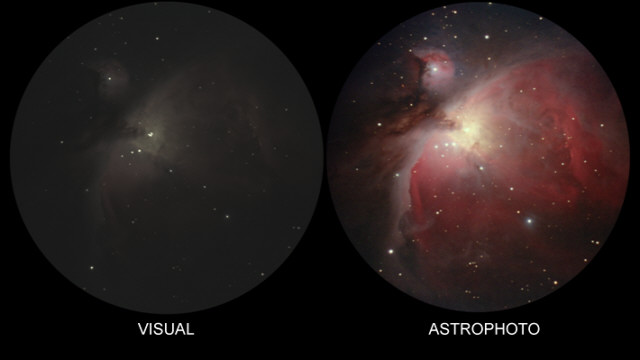 Initially M42 looked like a cloud, but more my eyes set on it, the true shape was visible. The dish structure - "wings" are truly awesome.. The "fish mouth" was dark and pretty big than I expected. 3 bright stars on SE are parallel to "fish moth". The Trapezium cluster at the top of the "fish mouth" is striking. I was easily able to resolve stars A,C,D, B .. From my 10x50 binocs, I guess I have seen only C star (not sure abt D) , but with the 6" dob, without any mistake the trapezium was visible. On SW of "fish mouth" another protruding dark tower is visible (don't know the name)..somewhat perpendicular to "fish mouth"and 1/3 rd in size. At SE of this tower there is bright a star hanging.
(Photo credit:.. from net somewhere.. the "visual" image is somewhat similar to what I saw, but I had clear and zoomed view..)
Had some focusing problem with the dob.. Stars weren't visible as precise points.. probably some parallax.. need to do some alignment.
Missed M43, at NE corner of M42... next time !!
Sirius was beautiful... like a big diamond.. because of clouds (or probably optics), there was some diffraction of light, causing visual of rays spreading out from Sirius.. it indeed gave me a feeling of "Tanishque / Jared" diamond... simply fabulous :) .... I wasn't aware that Sirius is a double star, but difficult to resolve... still.. will try it next time !!
M41 open cluster in Canis Major was easy catch. Its around 5 deg south of Sirius. Seems like it has ~50 stars, with lots of them in pairs. Wasn't able to resolve their colors.. but some of them seem to be reddish.. not sure.. In order to remember it, I tried to visualize some shape in the star cluster... Bright stars in the cluster seemed like forming a shape "E" with central line extended backwards, like a 3 pronged fork.. or its like a small "Trishul".
Any way... didn't spend much time today.. only 45 mins.. but surely a good start for year 2008... was planning for Messier Marathon at TDS today.. but weather sort of disappointed me..
Interesting Links:
- M42 at SEDS
- M42 sketches It looked somewhat similar from my 6" dob.

- Trapezium Cluster
- M42 Regional map
Subscribe to:
Posts (Atom)